Tabula rasa
Every morning a clean slate on which to write. And on being a clean slate

My process here on Substack is simple. I wake up and whenever it is clear I am not falling back asleep, and this clarity can happen anytime between about midnight and 5 or 6 am, I meditate. Usually by the time I open up Substack and hit Create Post, a title for the day’s post has come to me. Often the initial image or song has appeared by then too. And there it is, a tabula rasa, a clean slate on which words start appearing one by one.
Today it came before I got out of bed. Tabula rasa. A perfect reflection for Advent.
For those unfamiliar with the work of music:
The central work in Pärt’s instrumental music, the double concerto Tabula rasa has become one of the cult pieces in the music world and has prompted many composers and musicians, as well as concert audiences, to listen to and understand music in a completely new way…
The apparently simple music proved incomprehensible to the performers (who played the premiere). It is not an overstatement to say that the musicians, who were used to virtuosity and artistry, were suddenly face to face with the basic elements of music in Pärt’s score: triads and scales. This required a completely different approach, both interpretatively and psychologically. Gidon Kremer admitted that he was surprised by the reduced musical language of the piece and it took him a long time before finally realising the subtlety and intelligence hidden in these sounds. Nora Pärt, the composer’s wife has recalled that even after additional rehearsals the musicians felt powerless before the composition. However, when they started playing at the concert, all the pieces miraculously fell into place. Nora Pärt: “Never again have I experienced the silence that took over the assembly hall after the premiere.”
I cannot remember exactly when I discovered this incredible piece of music nor can I say how many times I have listened to it. I knew at once it was both deeply spiritual and revelatory without being able to explain why I knew or how it works. It thrills the heart and spirit while quieting the mind. You can see by the description above of the effect it had on the first performers of this musical piece of genius that it completely threw them off at first, even when they went through extra rehearsals. Yet somehow on the day of the first concert it all ‘miraculously’ came together.


εἶπεν δὲ Μαριάμ Ἰδοὺ ἡ δούλη Κυρίου· γένοιτό μοι κατὰ τὸ ῥῆμά σου. καὶ ἀπῆλθεν ἀπ’ αὐτῆς ὁ ἄγγελος.
Luke 1:38 - Mary replies to the Angel Gabriel that she is God’s servant and prepared to let this event happen to her, this God Being With humanity.
I was raised by a fiercely independent and strong woman to find this kind of mute submission to authority horrifying. Isn’t Mary being terribly passive? Where is her agency? And as far as we understand, Mary was very young, what we would consider now a teenager but at that time was simply a ‘young woman’, ready in the eyes of society to become a mother at a time when her body had not yet fully developed.
As beautiful as this music is, and as much as audiences around the world still delight in its sublimity, the sentiments it expresses are a struggle, for some insuperable, for the post-modern sensibilities of 2025 going on 2026.
…Thou shalt purge me with hyssop, and I shall be clean: thou shalt wash me, and I shall be whiter than snow. Thou shalt make me hear of joy and gladness: that the bones which thou hast broken may rejoice. Turn thy face from my sins: and put out all my misdeeds. Make me a clean heart, O God: and renew a right spirit within me. Cast me not away from thy presence: and take not thy holy Spirit from me…
Yet here too is found the spirit of tabula rasa. The willingness to be wiped clean of all that is past and to start anew.
It’s humility, not a quality greatly prized, to say the least, in today’s world.
But you know what? From a spiritual standpoint, not just in the Abrahamic faiths but in many other faiths and philosophical stances, humility is the beginning of wisdom. The concept of beginner’s mind, to reference only one example.
Knowing that I am not self-sufficient and all-knowing, but inter-dependent in every way and only having an infitesimal fraction of the knowledge that is out there.
For all the knowledge humans have accumulated is like a sandcastle a child builds on the shore of an ocean with depths the child knows nothing of.
(I touch on the vastness of human ignorance in previous posts like Knowing.)
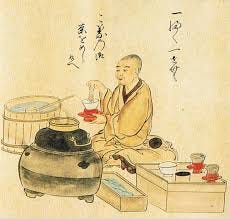
Once, a university professor went to visit a well-respected Zen Master to learn about Zen. The Master first invited him to sit for a cup of tea. The professor sat down and started talking about Zen. The Master quietly prepared and poured the tea. When the tea was filled to the cup’s brim, he kept pouring. The professor watched the overflowing cup until he could no longer restrain himself. “It’s full! No more will go in!” blurted the professor. “The same with your mind. How can I teach you Zen unless you first empty your cup?”
Thou art beautiful, O my love,
sweet and beautiful daughter of Jerusalem,
Thou art beautiful, O my love,
sweet and comely as Jerusalem,
terrible as an army set in array.
Turn away thy eyes from me,
for they have made me flee away.
Pulcra es amica mea lyrics in English
I do not know where this Advent journey of unknowing will lead, but I am ready to empty my cup to find out.