Os Mutorum
Mouth of the dumb, light of the blind... a medieval chant from Iona brought into the modern context by Scottish composer James MacMillan

Os mutorum
Lux cecorum
Pes claudarum
porrige lapsis manum.
Firma vanum
Et insanum corrige.
O Columba
Spe Scotorum nos
Tuorum meritorum interventu
Beatorum fac consortes angelorum.
Alleluia!
Mouth of the dumb,
Light of the blind,
Foot of the lame,
Stretch out a hand to the fallen.
Strengthen the unreliable
And correct the mad.
O Columba,
Hope of Scots,
By the intervention of your kindness,
Make us colleagues of the blessed angels.
Alleluia!

This dissertation provided useful background on the composer of the setting of this medieval text, James MacMillan:
Scottish composer James MacMillan, born in 1959, composed choral music throughout his life but initially rose to prominence as a composer of instrumental works in the early 1990s. In the first decade of the 2000s primarily with The Strathclyde Motets
MacMillan solidified his position as a preeminent composer in both choral and instrumental genres with international notoriety. MacMillan’s Roman Catholic upbringing and continuing faith have had a profound effect on his compositional style which is evident in both his instrumental and choral works. His skill in text-setting coupled with his deep faith provide a rich foundation for choral composition. This project provides contextualizing research on the subjects of MacMillan’s life,
I first became intrigued by MacMillan after being introduced to one of his most popular composition this past spring, O Radiant Dawn.
This morning, though, I looked up the translation to Os Mutorum for the first time, and was impressed by the words used to describe Saint Columba.
Mouth of the dumb,
Light of the blind…
I knew nothing about St Columba or the beginning of the Iona community but this article gave a brief history of his life and work:
Columba was born in Donegal in Ireland in 521 A.D. to parents who were of royal stock. Some accounts state that he was in line to the throne of Ireland but chose to relinquish this claim to serve God instead. At birth Columba was given two names; Crimm-Thann, meaning Wolf and Colum, meaning dove…
Columba was a brilliant scholar and mastered a variety of disciplines that served him well in his missionary endeavors throughout his life…
When he was 25 he built the church at Derry and planted a training school there in conjunction with the church, he remained here for seven years, using it as a launching pad to plant 300 churches with about 100 of these being missionary training centers as well…
Columba was focused, driven, hardworking, physically strong and mentally agile. While he was at Derry he also undertook the work of preaching, teaching, healing the sick and championing social justice issues on behalf of the poor. At a time when Ireland was a loose collective of warring clans, traveling the length and breadth of the Island, while navigating the political turmoil, was no mean feat but Columba commanded the respect of the various Clan chiefs to such an extent that he could do so unharmed…
Columba with 200 companions left Derry and landed in Mull Bay on the shores of Iona in 536 AD. Iona lay within the borders of the Gaelic kingdom of Dalriada and the Lord of Mull Bay being one of Columba’s relatives, offered him ownership of the island when he arrived. Iona was a pioneering mission station where everything, from buildings to crops, was raised from scratch by Columba and his companions... Columba not only oversaw the establishment of Iona but also managed to evangelize the neighboring Island of Mull in his spare time, helping to convert many who lived there.
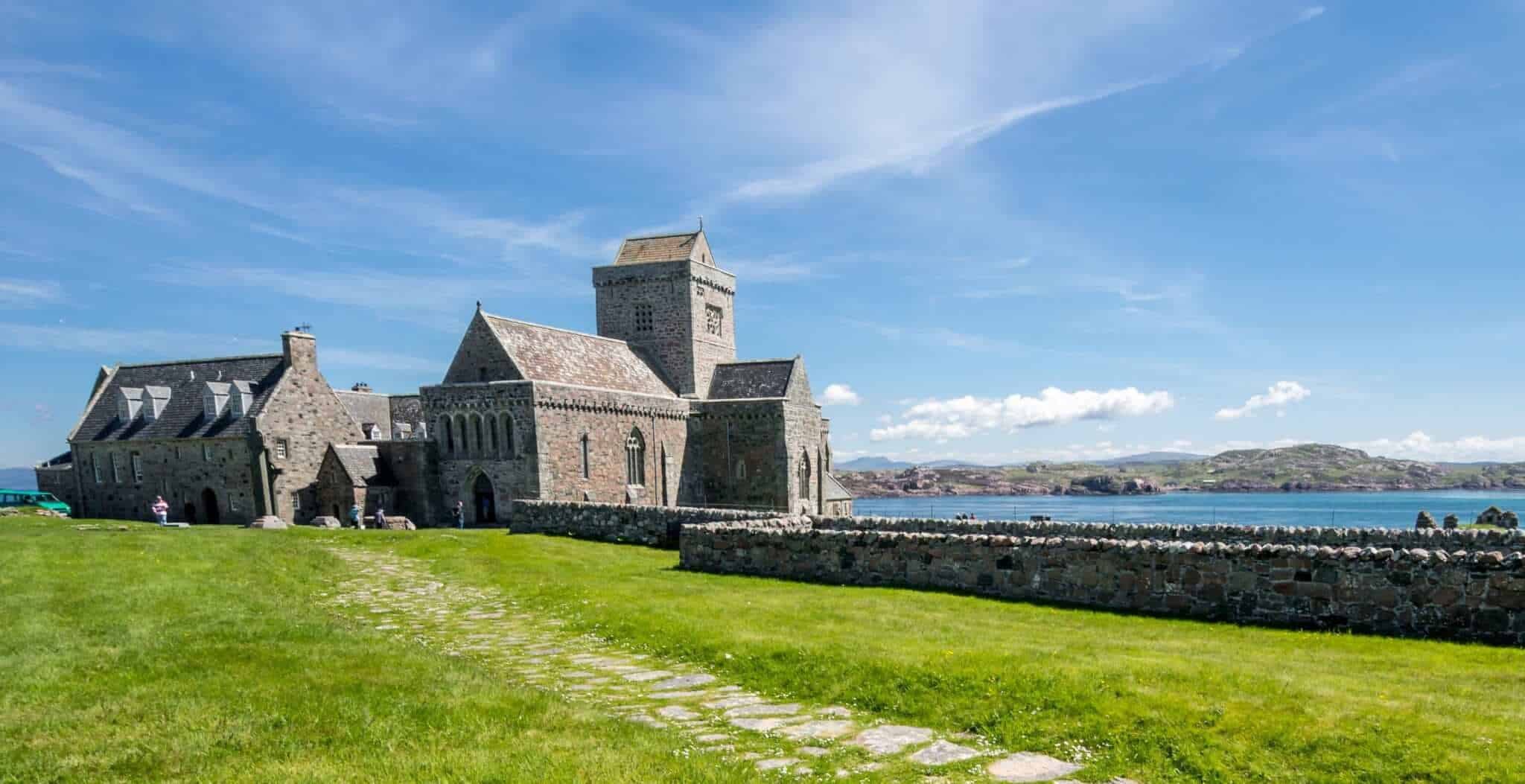
So maybe the panegyric didn’t overstate the case. He sounds like an extraordinary guy.
Not at all the image of the missionary many post-moderns have, of a person traveling to a distant country to lord it over unsuspecting natives and impose a foreign culture and religion.
Columba seems to have done everything. He transcribed hundreds of New Testaments by hand. He not only traveled right across Ireland and Scotland but held the respect of warring clan chiefs (that cannot have been easily won in such parlous times), healed the sick, built houses, planted crops, preached, taught, and worked hard for the poor and disenfranchised on social justice issues.
In other words, he lived the first four marks of Anglican mission in an amazing way. Perhaps the fifth mark too, as reverence for Creation would have looked totally different in the 6th century in Ireland and Scotland.
Lots of food for thought here.