Murderbot
My youngest recommends books and tv series to me. This is a book series we have enjoyed very much and we were both delighted when it was not only made into a series but a well done one.

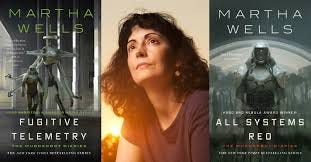
This article gives background on how Martha Wells wrote the books
In our family, two of my children and I have been reading the Murderbot books for years.
I should back up.
Almost from the time I taught myself to read in first grade, I have been an avid fan of science fiction and fantasy. I would go to the library and read everything that I could of an author and go to the next author. Rinse, repeat. I have no idea how many hundreds of science fiction and fantasy books or short story I have read over more than 50 years, but it’s a large number, I promise you that.
So loving these kinds of books is something I have in common with my oldest and youngest. And we have a particular fondness for Murderbot.
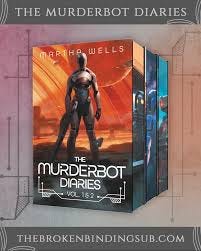
We have read them multiple times. So probably not a big surprise that I would suddenly decide to binge watch the episodes of the Apple TV series in batches over the past few weeks.
So what’s the appeal? The protagonist is not as bloodthirsty as the title might suggest. I don’t want to spoil the series for anyone by going into too many details, but Murderbot is an appealing character, a part robot part organic meld that is asexual, witty, and in spite of itself very protective of its humans.
The people, too, are delightful. And the character development as well as the way the relationships grow between Murderbot and the humans are enticing.
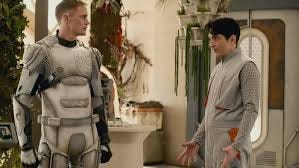
Guardian article about tv series
Of course, once a beloved book series becomes a tv series, you now have a whole new set of images in your head to go with the main characters and the scenes. Alexander Skarsgard in particular provides a particular interpretation of Murderbot as a clearly neurodiverse kind of individual. The relationship particularly between it and Gurathin is very well done.
If you have read my earlier Substack post about the dangers of considering AI as friends or intimates, or my notes on the topic, you may be confused about why I like Murderbot and other sci fi stories about sentient robots.
First of all, I never claimed to be any more logical or consistent than the next human.
But mostly, sci fi, whether it seems to be banging on about aliens or artificial intelligence, is really just about humans, isn’t it? Humans employ so many means in our endless quest for self-understanding, and one of them is using the idea of an artificially constructed being like Data or Murderbot to explore what it means to be human.
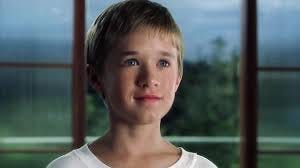
Some films like AI further ramp up the poignancy by casting an adorable little boy like Haley Joel Osment, who was so sweet in the 1990s, as the artificial being.
Anyway.
One of the things I have been trying to understand better about myself and those around me is how to improve conflict resolution in the context of building community.
Community is so essential to human well-being, yet increasingly difficult to find and nurture as we continue to race deeper into the 21st century.

This is why I was so encouraged to read in Ian Mobsby’s article When Forgiveness Becomes Prayer that as a rector he did one on ones with parishioners who were having interpersonal problems so they could work through them and forgive each other.
Being able to move from a dualistic dismissal of the other person, refusing to see them as even likable in any way, to a dear sibling in Christ who is just as human as you, and just as loveable, and to release the anger into true forgiveness and love, is nothing short of a miracle.
It’s the miracle we need, today.

I hope you had a wonderful Feast of St Nicholas!