Meet Your Patterns
Yesterday I downloaded a wheel from Daily Wellness called Meet Your Patterns. Prompts for Shadow Work. Intrigued to dive in this morning.

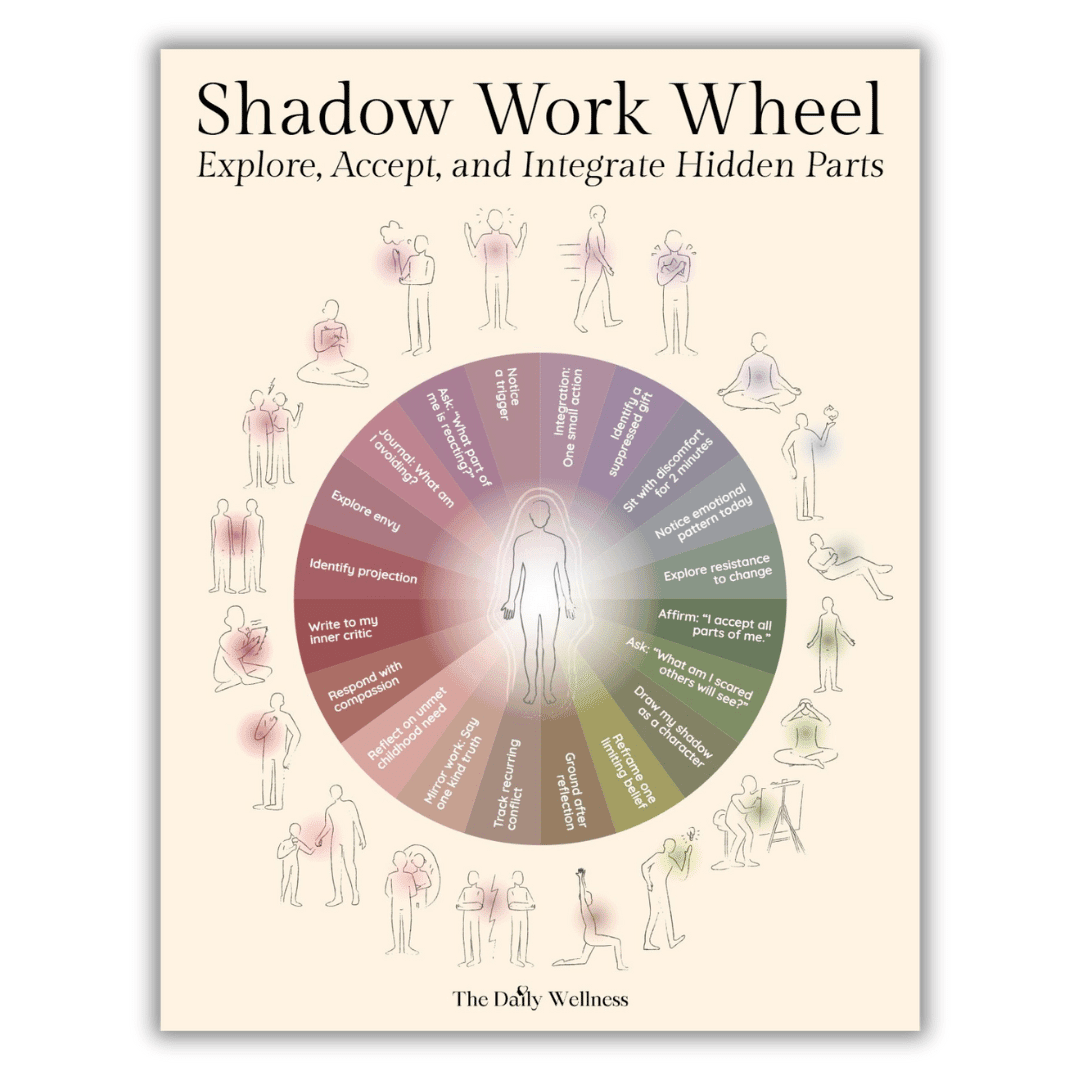
There are a couple of exploration paths depending on where you begin the wheel and which direction you move. Starting from the top, counterclockwise:
Notice a trigger
Ask, “What part of me is reacting?”
Journal, “What am I avoiding?”
Explore envy
Identify projection
Write to my inner critic
Respond with compassion
Reflect on unmet childhood need
Mirror work: Say one kind truth
Track recurring conflict
Or from the top, clockwise:
Integration: one small action
Identify a small gift
Sit with discomfort for 2 minutes
Notice emotional pattern today
Explore resistance to change
Affirm, “I accept all parts of me.”
Ask, “What am I scared others will see?”
Draw my shadow as a character
Reframe one limiting belief
Ground after reflection

I have been writing here daily right after sitting in silent meditation for 20-45 minutes. This morning I had a temperature regulation issue in the middle of sitting. I got uncomfortably hot. But instead of taking off my shawl and cooling, I stayed with the discomfort for however long it lasted. Probably wasn’t more than 5 minutes, likely less. Felt like a long time. This is one of the big lessons of meditation: sensations, however intense or unbearable they may feel in the moment, always, always pass. Then they are gone, often without a trace. Lessons in impermanence, and non-identification with feelings and sensations. “Sadness is on me.” Not I am sad.

When I was first introduced to Centering Prayer in 2011, I found it striking that emotions and thoughts were likened to clouds going overhead in the sky. Or boats moving down a river. There is no gain to trying to attach to a cloud or a passing boat. There it is. There it goes. Oh, it’s gone now. Just let it go.

I notice sometimes I get angry and impatient with someone who is not doing what I am expecting them to do.

Hard to say where the anger is or where it comes from. It suddenly flares in the chest, I suppose, without warning.
I feel that it stems from a sense of not being able to have control over the other person’s actions. Having told them what I expect them to do, the correct, clear action that is only reasonable, I see they persist in not doing it, and anger flares.
A memory rises up from over 20 years ago. I was at church and there was a bit of a mess on the carpet. I got distressed and was going to get a vacuum and hoover it up. The priest stopped me, and said gently, it was ok, it could get cleaned up later. I said, irritably, that it needed to be cleaned. He said even more quietly, “And what if it doesn’t get cleaned up? What will happen?”
What is the terrible, awful thing to be avoided at all costs that will happen if that action I am trying to have control over does not succumb to my attempts at control?

That’s right.

Nothing happens. Life goes on, moment by moment, same as it ever was.
The ‘monstrous’ truth I do not want to face? I don’t have a lot of control over things. Certainly, I cannot control people. People will people, all day long. Humans will keep humaning.
But you know what? It is absolutely ok.
Dear inner critic,
I know you want to jump in right now and start beating me up about how I could possibly get upset over something so silly, so trivial. What’s the matter with me? Why can’t I just… on and on.
But you know what? That’s nonsense. It is completely human to get distressed over the locus of control for many things that matter for me being outside of me. Rather than focusing on what I can control, I can tend to stress over what I cannot. Because I am a person, and like all other people in the world, I people.
Just as much as it is ok that that person keeps doing what that person keeps doing until they decide to do something else, it is ok that I found it upsetting yesterday, and might find something similar upsetting today.
Yours truly,
Me.

One of the many things I have totally adored about Thich Nhat Hahn’s approach to life is his delightful approach to strong emotions and pain, smiling at them: “Hello, my little anger. I know that you are there. I will take good care of you.”

“As a practitioner, we should be able to smile to our anger, to our irritation. Smiling at it means you are aware of it. You don’t try to suppress or to run away from it. And with the energy of mindfulness you are strong enough to be with your anger, to be with your irritation, to be with your loneliness. And the first function of mindfulness is to recognize things as they are.” (Same source)

One of the things I have found so attractive about Buddhism as a philosophy is the approach to emotions as something to develop one’s skill, through daily practice.
Venerable Thubten Chodron, like many other Jews, was drawn to a life devoted to Buddhist dharma.
‘Cultivating love—the wish for sentient beings, including ourselves, to have happiness and its causes—prevents as well as counteracts anger. We may wonder, “Why should we wish those who have harmed us to be happy? Shouldn’t they be punished for their wrongdoing?” People harm others because they are unhappy. If they were happy, they would not be doing whatever it is that we found objectionable, because people don’t hurt others when they are content. Instead of seeking punishment or retaliation for harms done to us, let’s wish others to be happy and thus free from whatever internal or external conditions precipitate their negative actions.
We cannot tell ourselves we must love someone; rather we must actively cultivate this emotion. For example, sitting quietly, we begin by thinking and then feeling, “May I be well and happy.” We spread this thought and feeling to dear ones, then to strangers, and to people we find disagreeable, threatening, or disgusting, and say again and again to ourselves “May they be well and happy.” Finally, we open our heart and wish happiness and its causes to all living beings everywhere.’

The unmet childhood need, here, was not to feel powerless.
How does a one year old baby feel watching her mother leave, and feel every day when she does not return for a year?
Or a two year old feel watching her leave again with the toddler’s sisters, while the toddler waits another year for their return?
Anger is easier to feel, isn’t it, than that profound grief?

After the shower of tears, a burning tightness in the chest, which became an ache in the throat, which became a painfully tight jaw. Oh.
One kind truth: I am deeply loved, and I am never alone.
