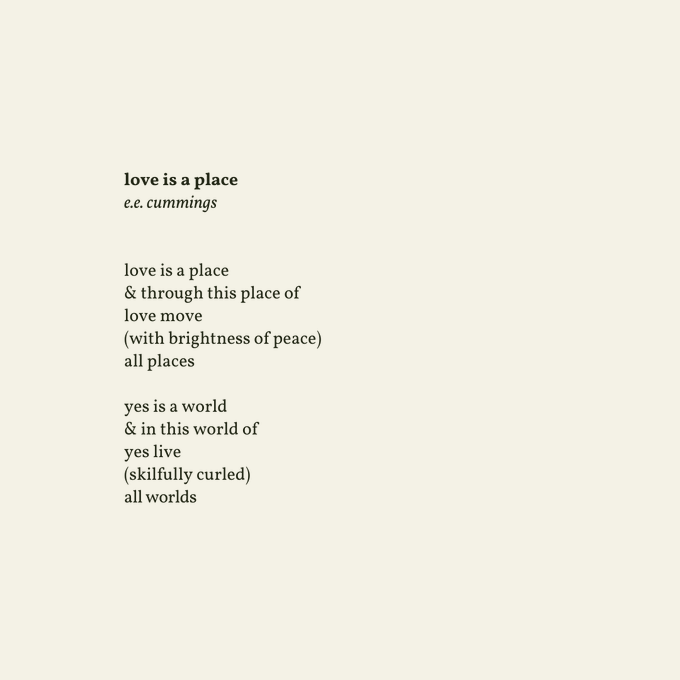
Love Is A Place
A poem by E.E. Cummings. An article in 4 parts by Rupert Spira. A wander through all four parts.

Rupert Spira gave this talk, of which this article is the first part, in Italy in 2015 at a non-duality conference.
He began:
“The first thing I want to say, and I’m afraid this is going to be a little disappointing to you, is that we are going to hear and speak a great many words this week about the nature of Consciousness, and not a single one of them is going to be absolutely true.
If we wanted to speak the truth about the nature of Consciousness, experience or reality, we would have to remain silent. That is why it’s said that the highest teaching is silence.
However, very few of us are sufficiently mature to intuit the reality of Consciousness from silence. Therefore, the spiritual traditions have elaborated various paths, various skilful means, tailored to various levels of our understanding. So it is in that spirit that I speak of the nature of Consciousness.”
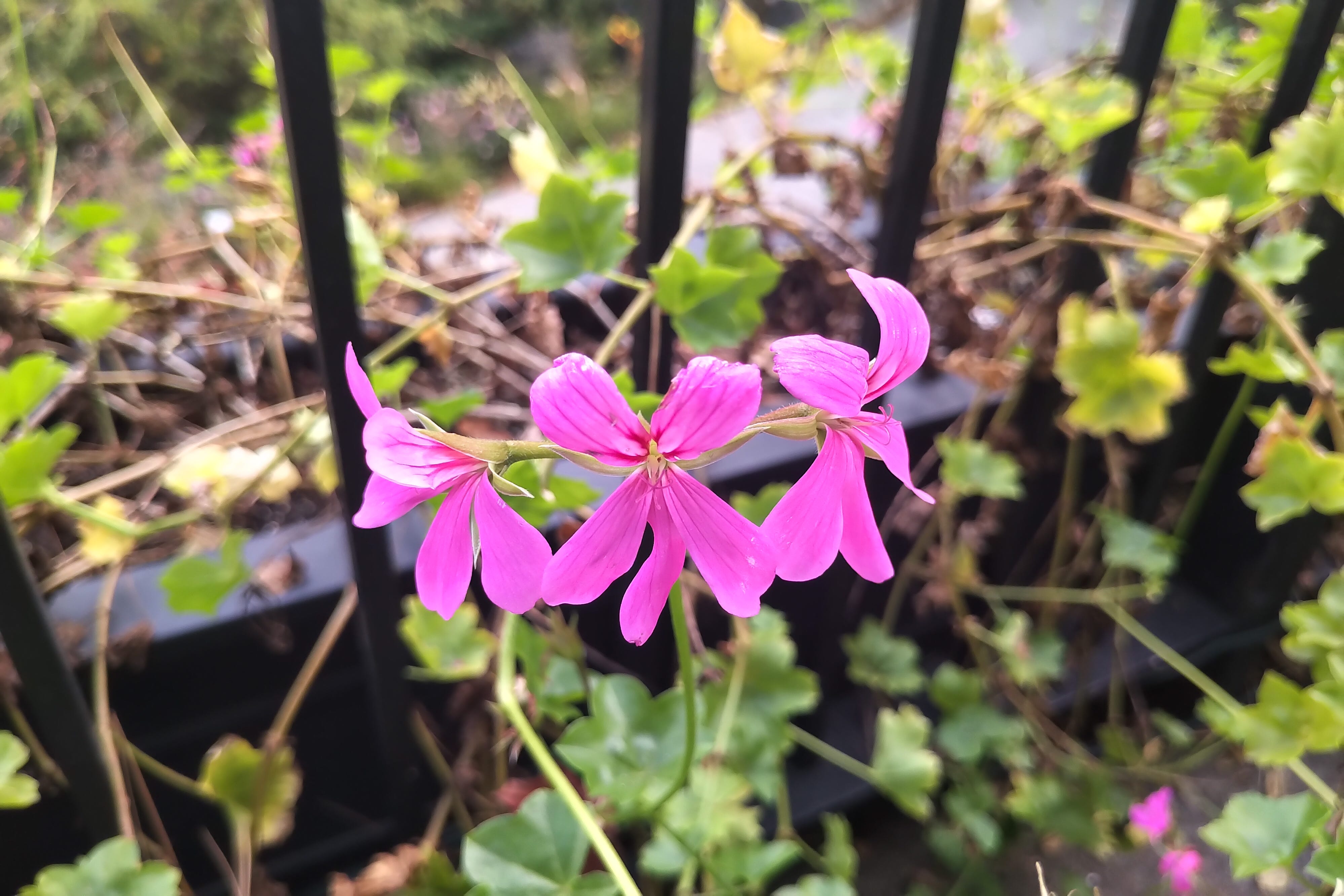
(One of my pictures from my All Saints personal silent morning at the Rock Garden)
Rupert goes on to do, literally, a kind of thought experiment.
“Take a thought, or allow a thought or a series of thoughts to appear, and notice that those thoughts appear in some kind of field. They appear in something, so let us say they appear in space. Consciousness is not actually a space — in fact, it has no dimensions — but let us provisionally give Consciousness a spacelike or fieldlike quality, and see that whatever thoughts are appearing are appearing in this spacelike, aware field.”
His preliminary conclusion is that nothing can be contacted outside of Consciousness or Awareness.
He ends part 1 thus:
“Therefore, Awareness is a legitimate field of study, simply because it is experienced. Everybody here is knowing or aware of their experience. What is the nature of the Knowing with which experience is known? That is the interesting question. Until we know the nature of the Knowing with which our experience is known, or until we know the nature of the Consciousness in which our experience appears, we cannot know anything that is true about the mind, the body or the world.”
”Tell me one true thing.”
There is a deep hunger inside the human heart to know that something is true, anything, is there not?
And a terrible sense of betrayal when a human learns another is lying. But worse, that there is a bigger lie on which what we thought our reality was built.
How each of us believes
I’ve never really known
In heaven unseen and hell unknown
How each of us dreams to understand anything at all
Why each of us decides
I’ve never been sure
The part we take
The way we are
Why each of us denies every other way in the world
However unsure
However unwise
Day after day play out our lives
However confused
Pretending to know to the end
But this isn’t truth this isn’t right
This isn’t love this isn’t life this isn’t real
This is a lie (full lyrics)
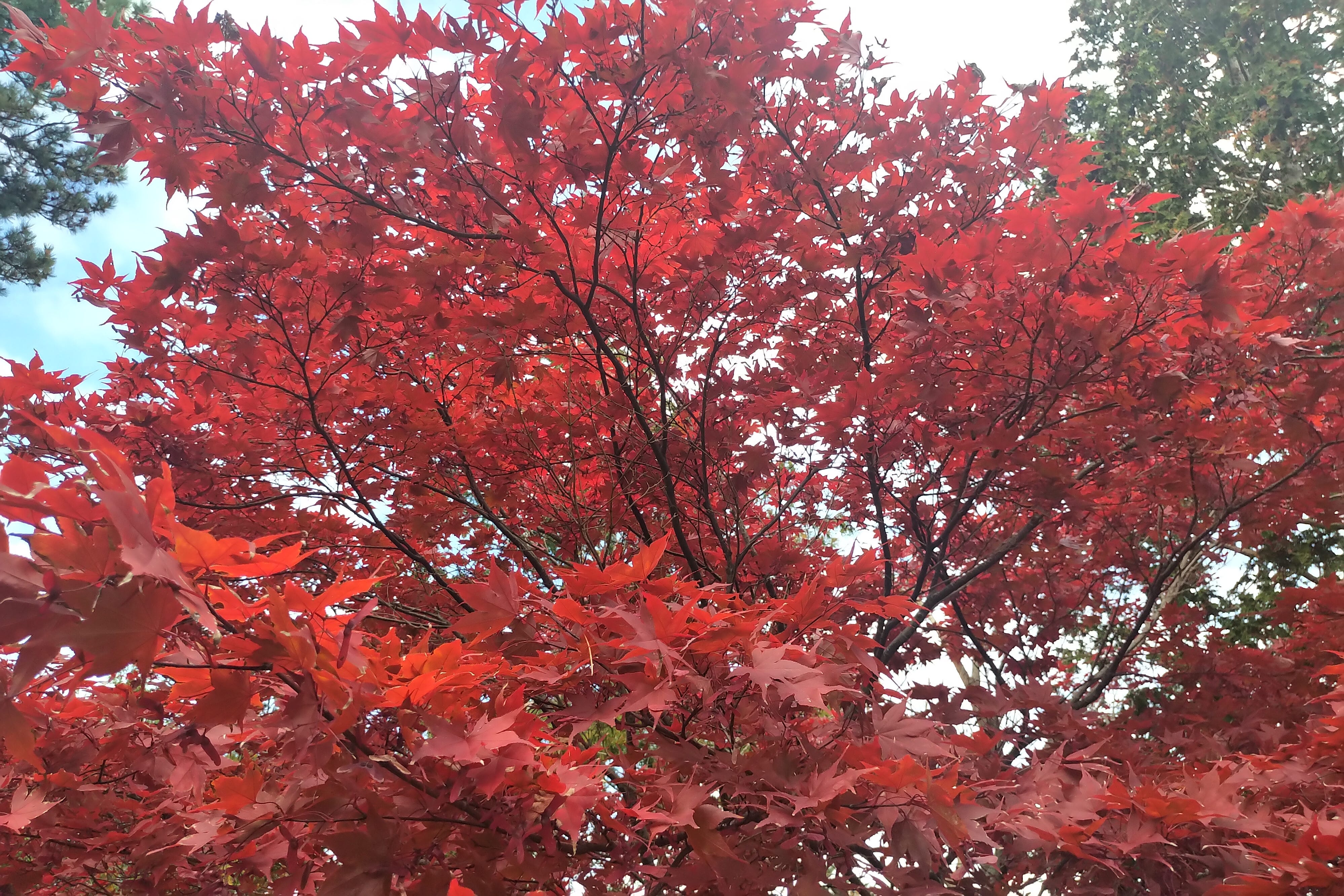
(Image: gingko leaf details, from my Rock Garden pictures, November 1 2025)
What if there were a way to understand Reality, as it really is?
This is what Rupert Spira seems to be offering.
Let’s see what he says in Part 2.
Rupert continues the ‘thought experiment’ begun in part 1, exploring what happens between the question asked, “Are you aware?” and the answer, “Yes” then says
If we ask thought about the nature of Awareness, thought will tell us that every single body has its own package of Awareness. But if we ask the one who knows, that is, if we asked Awareness itself, ‘What do you know about yourself? What is your experience of yourself?’ Awareness would reply, if it could speak, ‘I have no knowledge of any border or distinction or form in myself. I am a single open, empty, indivisible, intimate field.’
That means that the Knowing or the Consciousness with which each of us is knowing our experience is the same Consciousness. It means that Consciousness can never be divided into parts or objects or selves. It means that if each of us were to take the thought ‘I’ and trace that ‘I’ to its origin, to its source, and if we were to trace it far enough back to the essential nature of each of our minds, we would all arrive at the same Consciousness. There cannot be two infinite, empty spaces.
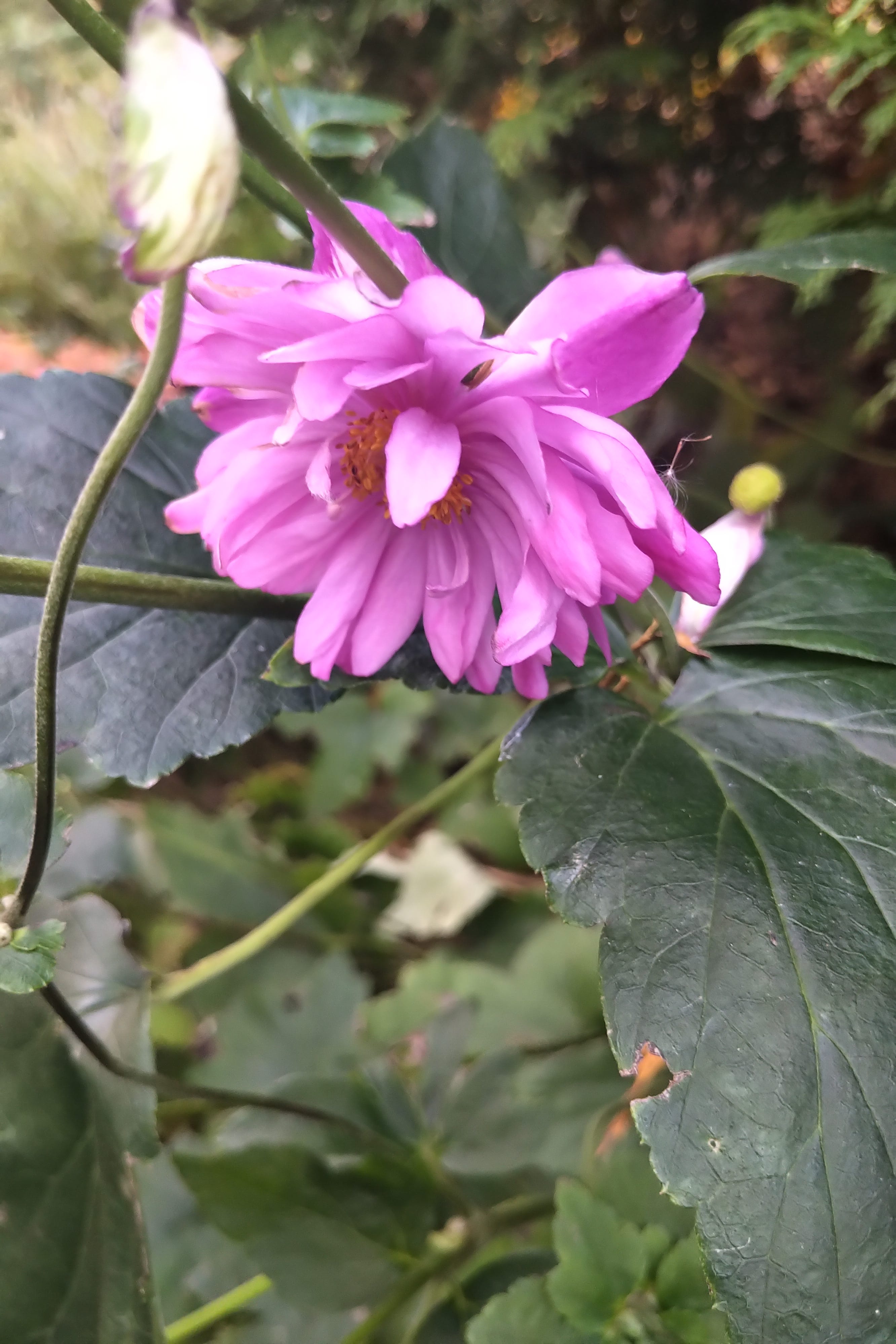
Image: a flower blooms at the Rock Garden. Does a flower participate in Awareness? Apparently…
Rupert ends Part 2 with this statement:
All that is being experienced at this moment is Consciousness, modulating itself in the form of the finite mind, that is, in the form of thought and perception. In the form of thought, it appears to itself as time, and in the form of perception it appears to itself as space. Time and space are Consciousness modulated through thought and perception.
As he moves to Part 3, Rupert invites us deeper into the thought experiment, and to
(i)magine a woman named Mary falling asleep here in Titignano. Mary’s mind is a single indivisible whole, like each of our minds, and Mary dreams that she is Jane walking the streets of New York. So, Mary’s mind has fallen asleep to its own infinite, indivisible nature and imagines instead that it has assumed the limited form of Jane’s mind. Jane is walking the streets of New York, seeing people, cars, buildings, which from Jane’s point of view all seem to be outside her mind…

Jane goes on, as humans do, to fall in love with David, whom she meets by chance, and in time, experiences that temporary relief from the feeling of separateness we call sexual intimacy.
In this moment of merging there is a temporary loss of all the limitations with which Jane defines herself. There is a temporary collapse of Jane’s finite mind, and in that moment she tastes the essence of her mind, which is Mary’s peaceful mind asleep in Titignano.
Now, of course, when Jane and David part, this temporary suspension of suffering comes to an end and she feels everything that defines her again. The suffering bubbles up again and she remembers, ‘Ah, the last time I united with David the suffering went away. Therefore, uniting with a person, an object, a substance or an activity must be the way to get rid of my suffering.’

So Jane goes again and again to the object, the substance, the activity or the relationship, in order to find relief from her suffering. Indeed, each time she unites with the object, activity, substance or relationship she does find temporary relief, and this builds up in her the conviction that the way to be free of her suffering is to continually acquire objects, activities, substances and relationships. She ends up being addicted, like most people are, to some kind of an object.
The subtlest object, of course, is thought, and this is the main addiction. It’s free and not bad for our health, so it’s an addiction that doesn’t normally get labelled as such. Nevertheless, it is an object towards which we give our attention, mainly in order to distract ourselves from the wound of separation that all apparently separate selves carry around within themselves.

If you meditate silently, especially on a regular basis over a period of decades, you know the profound sense of relief that the momentary release from the tyranny of thoughts brings. While thoughts come and go during any given meditation, the attachment to them is gradually lessened, and the idea that you are your thoughts is also less and less compelling.

Part 3 ends here:
In other words, when Consciousness brings manifestation into existence, it comes at a price. Consciousness overlooks the knowing of its own Being, gives birth to the universe from within itself and then finds itself located as a self in that universe. In order to bring the universe into apparent existence, Consciousness has had to forget its innate nature of peace and freedom, and that is why ‘the self in the world’ longs for one thing alone: peace and freedom.
The only activity the separate self is really engaged in is the discovery of peace, freedom and happiness. It first tries to do this by uniting with objects, substances, states and relationships, but at some point it gets to the end of that adventure. It realises that it can never be fully satisfied by objective experience, and that is when the real journey back home begins.
Who hasn’t had this feeling of not being able to be at home in the world as we know it?
Existence comes from two Latin words, ex and sistere, meaning ‘to stand out from’. Nothing stands out from Consciousness; nobody has ever found a place outside Consciousness. No thing comes into existence. Objects borrow their apparent existence from God’s infinite Being, the only Being there is.
The very ‘I’ that each us is now feeling as ‘myself’, the ‘I’ that I am, is infinite Consciousness itself, God’s infinite Being. It is the reality, the substance out of which all experience is made.

God’s infinite Being shines in each of our minds as the knowledge ‘I am’. That is why the ultimate spiritual practice is to give the ‘I’ that I am our attention, to allow the mind to sink back into its subjective source. As it does so it is temporarily, in most cases, occasionally suddenly, divested of its finite limitations and stands revealed as infinite Consciousness, God’s infinite Being, the only Being there is, the heart that we all share, the heart we all are.
I would suggest that the experience of love is simply the knowledge of our shared Being. When we love, we feel one with the other. Love is the experience of our shared Being. Is there any experience the separate self desires more than the experience of love?

All Jane needs to do to be relieved of her suffering on the streets of New York is to ask herself, ‘What is the nature of my mind?’ If Jane enquires deeply enough into the nature of her own mind she will discover that her agitated, finite mind is made of Mary’s peaceful, infinite mind. That’s all there is to Jane’s mind. All there is to each of our minds is the inherently peaceful presence of infinite Consciousness.
And, finally, part 4 ends here: