39/40: Catharsis
Entering into the grief of this day is a way to let go of feelings repressed far too long.

I spent a fair part of today’s meditation crying. I really, really needed to cry today.
My early training as a child (“don’t cry or I’ll give you something to cry for!”) led to silently carrying for decades an untold number of heavy, hard, sad things that I did not feel that I had permission to cry over. Instead I smiled or even laughed, pushed down the feelings that were not allowed, buried them.
Music is a powerful means of catharsis. No surprise then that listening to a piece of music, new to me and composed to go very deep into grief, was how I reached the vulnerable place where ‘crying meditation’ was what arose today for me.
The composer, Eric Whitacre, in his notes on this piece, wrote:
The text, one single, devastating sentence, is from the King James Bible; II Samuel, 18:33:
When David heard that Absalom was slain he went up into his chamber over the gate and wept, my son, my son, O Absalom my son, would God I had died for thee!
Setting this text was such a lonely experience, and even now just writing these words I am moved to tears. I wrote maybe 200 pages of sketches, trying to find the perfect balance between sound and silence, always simplifying, and by the time I finished a year later I was profoundly changed. Older, I think, and quieted a little. I still have a hard time listening to the recording.
I invite you if you haven’t yet clicked through to the recording to listen to it, all nearly 18 minutes of it. I recommend that you prepare to have a box of tissues at the ready before you start.
The 18 Part Chord
Short of time or emotional bandwidth? This is a 55 second clip of the early iteration of ‘my son, my son’ leading up to the 18 part chord that is difficult to describe and devastating emotionally.
Why Do We Need Catharsis?
κάθαρσις :
In criticism, catharsis is a metaphor used by Aristotle in the Poetics to describe the effects of true tragedy on the spectator. The use is derived from the medical term katharsis (Greek: “purgation” or “purification”). Aristotle states that the purpose of tragedy is to arouse “terror and pity” and thereby effect the catharsis of these emotions. His exact meaning has been the subject of critical debate over the centuries. The German dramatist and literary critic Gotthold Lessing (1729–81) held that catharsis converts excess emotions into virtuous dispositions.
Catharsis: Psychological Release, Emotional Purging, And Tragedy
Music, of course, is not the only art that facilitates the powerful release of emotion we call catharsis. Drama (live theatre or screen depictions most accessible today), poetry, fiction, paintings, sculptures, and other artistic expressions ‘arouse terror and pity’ as well as all the colours and textures of grief and other emotions we as humans struggle to contain in our fragile bodies.
Perhaps like me, when you need ‘a good cry’, you read that book again which leads you to that place, or re-watch that movie or television episode that leaves you weeping and yet strangely satisfied.
What is ‘Good Grief’?
I just discovered this poem while looking online for help with ‘good’ grief.
The night I lost you
someone pointed me towards
the Five Stages of Grief
Go that way, they said,
it’s easy, like learning to climb
stairs after the amputation.
And so I climbed.
Denial was first.
Linda Pastan, “The Five Stages of Grief”
I have been thinking about ‘good grief’ for a long time. A dear friend who was a Buddhist and thus embraced a ‘good death’ when she was facing inoperable cancer and had a relatively short time to prepare herself, her family, and friends taught me about grief compassionately and lovingly. But another dear friend whose death I didn’t anticipate died the very same day, and the combination of the two deaths led to a level of grief I dealt poorly with, that led to other losses and griefs. It took me a long time to ‘recover’. Would it have been worse without the preparation? I will never know.
‘Early grief’ takes at least 2 years and can be much longer.
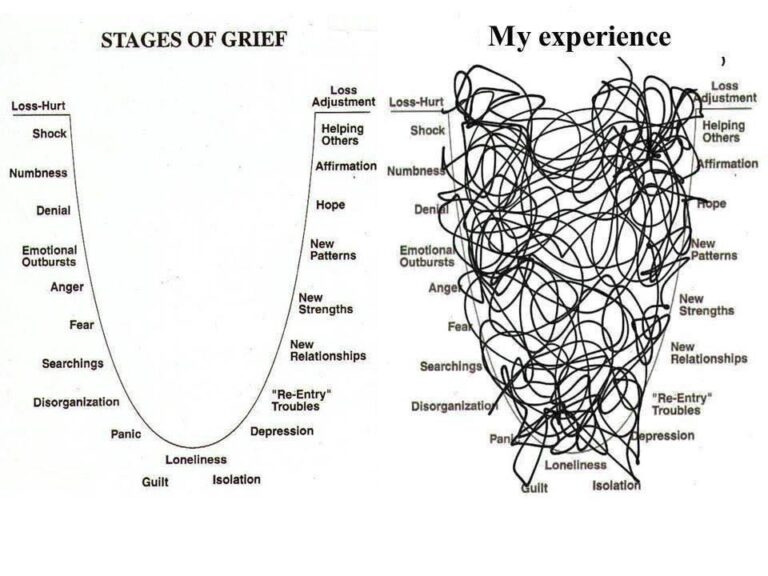
(Image from Why the Five Stages of Grief are Wrong)
I’m no expert, but perhaps ‘good grief’ is just experiencing it as fully as we can. That capacity will change from moment to moment and over the years, but if we can as a society get over simplistic ideas about grief and stop normalising denial of death as a default setting, it would tremendously help people who grieve.
So Here We Are. Good Friday
This is a day in the Western tradition and calendar that holds space for grief perhaps better than any other. It doesn’t take having a lived connection to the Christian faith to feel that the death of an innocent man by excruciating torture under the hot sun is a horrifying and painful wrong.
Some will go to Good Friday services, while others will attend concerts of powerful music like this work, which the Central Presbyterian choir and friends like me will be singing tonight:
The Jewish community worldwide is also at the time in the middle of the celebration of Passover, in a year when anti-semitism is being normalised to a terrifying extent, during a war between the US, Israel, and Iran, and while the Ukraine war continues to drag on. Police protection for synagogues and Jewish schools has intensified for the holidays.
This chosen nation has known far too much grief.
May we remember that our being here is something no human can explain or understand.
May we remember that we are responsible to those who came before us and those who come after us.
May we remember that it is very, very easy to destroy, but infinitely harder to build.
May we remember that there is no future for any of us without all of us.
Prayer for Israel’s present and future
The Sacred Encounter of Each One with Loss
This article has been all over the place, nothing like linear, something like the ‘my experience of grief’ image. You may be feeling some mental or emotional whiplash from it all.
Where I wish to leave off is here: each human has had to experience many losses throughout life. At times the weight of all the loss may feel crushing, more than it is possible to bear. There is no script. Every one of us has a unique journey.
Through the honest, open, sacred encounter with my own emotions, through cathartic encounters and other means as they arise in the moment, I hope to learn how better to be with others in their sacred and difficult encounters.
We all are ultimately alone in one sense, but there is at the same time a true shared journey, the holding of space one for another, co-regulation when feelings exceed the bounds of personal capacity of that moment.
I was raised to believe that men shouldn’t cry. I was a soldier and a pretty tough guy, but I still cry. Stress and emotional pain become like unpaid bills if we repress our feelings. Jesus wept - why shouldn’t we?
This reached me at exactly the right moment. I’m moving through my own grief at the moment, and today in particular felt like a day where all I could do was cry. I ended up spending a good part of my meditation just letting that happen, and reading this made me feel less alone in that space.
The way you speak about catharsis, and the permission to fully feel what’s there, was incredibly comforting. Especially the idea that “good grief” might simply be allowing it to be experienced as fully as we can, without trying to shape it into something neater or more acceptable.
There’s something deeply relieving in having that reflected back, that crying isn’t something to move past quickly, but something that has its own place, its own intelligence even.
Thank you for writing this. It met me in the middle of something I really needed to feel.