3/40: Being With
"I was a stranger and you invited me in, I needed clothes and you clothed me, I was sick and you looked after me, I was in prison and you came to visit me.’'

I began this personal 40 day practice of ‘letting go of encumbrances’ on Wednesday with working with letting go of control and continued yesterday reflecting on letting go of resistance.
I was inspired to focus today on letting go of avoidance by this post by Mark in France.
Humans are by our nature inter-dependent. People have sadly weaponised intentionally ridiculous, sarcastic sayings like “pull yourself up by your bootstraps”, imagining they or anyone else could ever possibly go it alone.
No one can. Intrinsically we depend upon thousands of people and more other living beings, factors, and circumstances for every moment of continuing existence.
Despite the fact that it is clear we all rely on so many others every day, it was necessary that a prayer be incorporated into the Anglican Book of Common Prayer liturgy in the late 1800s to motivate those who prayed it to wake up to the desperate needs of the people around them on every side.
Isaiah 58:3, 6-8 spoke to this issue thousands of years earlier:
Look, you serve your own interest on your fast day… Is not this the fast that I choose: to loose the bonds of injustice, to undo the straps of the yoke, to let the oppressed go free, and to break every yoke? Is it not to share your bread with the hungry and bring the homeless poor into your house; when you see the naked, to cover them and not to hide yourself from your own kin? Then your light shall break forth like the dawn, and your healing shall spring up quickly.
Jesus picked up the theme in his time (Matthew 25:35-40):
35 For I was hungry and you gave me something to eat, I was thirsty and you gave me something to drink, I was a stranger and you invited me in, 36 I needed clothes and you clothed me, I was sick and you looked after me, I was in prison and you came to visit me.
Being with each other in alleviating physical hunger and thirst, in clothing and housing the needy, in caring for the ill, in accompanying prisoners in their isolation.
It turns out these are actually ways to be with Presence Itself.
Meeting Physical Needs Without Strings
One of the things the Anglican Cathedral in Hamilton does well, I think, in conjunction with St Matthew’s house and the city, is the 6 day a week Cathedral Cafe which offers breakfast and lunch daily to hundreds in need. Guests also may access the washroom, be in a more comfortable space in extreme weather, and access a wide variety of other forms of assistance in supportive programs.
The Cathedral has further extended its support in this harsh winter of 2026, for the months of February and March, to providing six day a week overnight shelter.
Meeting the needs of those who are hungry, thirsty, and lacking safe shelter can seem overwhelming. But volunteering for and financially supporting something like the Cafe, one of a plethora of such organisations worldwide, is an obvious way in.
It must be without any strings attached.
People need to know they can come somewhere for help without being asked to believe in anything or do anything in return. They must be able to be accepted and not judged. Only then may they experience being accompanied in the time of need.
Clothing Those Who Need It
Those of us who are privileged to live in nice houses or apartments and to enjoy comfortable lifestyles can easily help with urgent needs that come up at times like this. Providing warm socks and good boots or shoes is vital for people who spend much time outside in the winter in places like Canada. This is only one example of ways to share.
Perhaps it is more a question of attention and time than not having the actual resources. I know I, for one, can get so wrapped up in my own life and concerns to the exclusion of doing simple things that would make a significant difference to the life of another.
Letting Go of a Stance of Avoidance
Avoidance for me means that I have gotten stuck inside my own head and am not really available to those around me. It’s more than not sharing physical resources, helping the ill, or visiting prisoners.
It’s forgetting that simply being with another, completely, without distraction, can be a profound source of support and healing.
There are many ways humans are prisoners besides being in a physical jail. People can be imprisoned by addictions and other forms of suffering such that every day is a torment.
Something I have noticed every time I am here in Tobago is that most people say, “Good morning” or “Morning morning” to a stranger. The human interaction of greeting another, smiling, and waving, rather than just walking by each other as the other does not exist, is a humbling reminder that it doesn’t have to take much to be with each other.
Truly accompanying someone else in a time of despair and emotional need is naturally much more involved than simply saying, “Morning morning”.
I have to start somewhere though.
What If Being With Drains Me?
I do not always feel that I have the emotional resources to be wholly with someone, especially someone with whom the interaction feels largely one way. It’s been a challenge while here to sit lovingly with my mother as she slips gradually deeper into dementia and to be patient to listen to the same loop again and again. There have been days when I have allowed the busyness of my remote work and my fatigue between meetings to mean that I skipped visiting her.
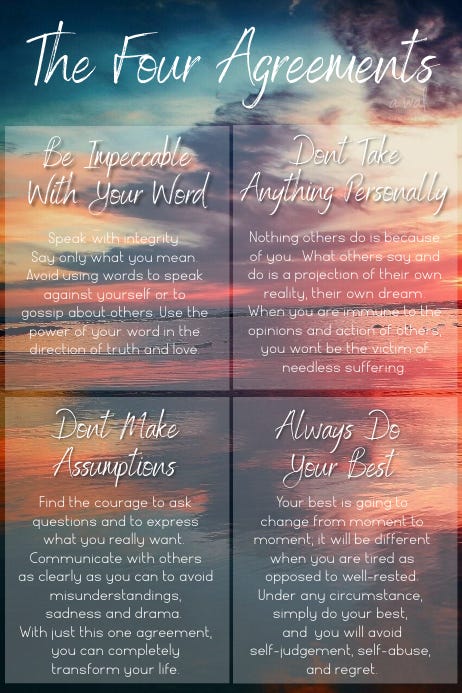
I return at times like this to Miguel Ruiz’ Four Agreements, especially ‘always do your best’. As Ruiz says, ‘Your best is going to change from moment to moment. It will be different when you are tired as opposed to well-rested.’
I am not sure how stern your inner critic is. Self-judgment and regret can be painful parts of daily life if you are recovering from trauma and wounding. Perhaps you grew up surrounded by people who reinforced messages of you were lazy, stupid, etc.
The truth is, though, best is as good as anyone can do. So it needs to be good enough.
Learning to ‘top up’ when tired by wellness practices like a brief meditation, quick nap, walking to clear the head, properly hydrating, and so on helps provide parts of the means to be physically up to however being with is inviting me on a given day.
What If I’m Actually Avoidant?
Possibly 4 % of people have an avoidant personality. There are also other reasons due to personality and temperament and various factors that could make it difficult for people to be with others in more than intermittent spurts.
I posted this in the first article in this series, which applies to everything I write here or anywhere:
Disclaimer: as always, this is just based on my personal thoughts and experiences. I am not a therapist and if you have significant traumas, wounds, or mental health issues related to anxiety or anything else that feels related to the following, this is not intended for you. The intention is always for me to muse on something that has come up for me from my privileged position of relative health and security.
True avoidance is a seriously difficult way of being. There are good therapies and therapists out there who have helped people in this, but no quick or easy fixes.
Again it is a question of doing one’s best. It may look like a very extroverted person who delights in being with people and is energised by that is doing a superlative job of being with, when actually they are just living out the way of being that is most natural and happy for them.
Western society has a tendency to prioritise and showcase extroversion and workaholism as if they are good in and of themselves, rather than recognising there are all kinds of people with all kinds of personalities, and it’s perfectly fine. Also workaholism is a form of addiction, regardless of how frequently it is rewarded.
What It All Comes Down To
My takeaway for myself personally is that I feel invited to be more fully present in my life to those around me. It is all too easy for me to be focused on myself and my own needs and interests to the exclusion of helping others. Help can be through simple physical ways, providing resources, or helping ease the emotional suffering of others by companioning them and being with them in whatever they are going through at this moment. Or both.
As a final thought, the current Being With course I am participating in as a co-leader is Being With Yourself. It reminds me each week I prepare and participate in a session that the foundation of being able to be with others is to more wholly meet myself, to companion myself.
“Love your neighbour as yourself.”
Remember to put on my own oxygen mask before helping another.
I’m always keen to hear your thoughts, so don’t hold back.
think I am a work in progess