29/40: Self-forgetting
In the last week and a half of this personal 40 day journey, taking a look at letting go of the suffering of self-preoccupation.

Some Words We Lost Down the Couch
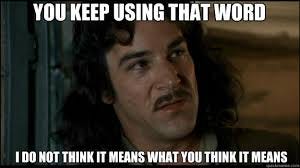
Perhaps the Princess Bride surprised everyone with its success, the way it became a cult classic. I cannot say how many times I have watched it, and laughed and laughed, and been moved.
This line is one of the most memorable ones.
I’ve had a deep love of words, languages, in fact of all things communicative since I was small. As such I have definitely misused more than my fair share of words. An avid reader like me sees countless words in books that she seeks to understand in context, and then often mispronounces them and also uses them out of context, not having fully apprehended the sense needed for other situations.
Please understand me then when I talk about self-forgetting. It may not mean what you think it means.
It’s Not Erasing Myself
One of the forms of suffering that keeps coming up around here in a number of excellent articles I read is the peculiarly feminine (remembering men, too, have feminine qualities and thus may suffer acutely from this) tendency to try to disappear, not to be inconvenient. To erase ourselves.
It comes from a deep well of suffering. It can too often be from trauma and violation. Definitely at a minimum from some kind of wounding whereby the small child realises that they are unwanted in some sense. Too loud, too fast, too much, too … child. So they learn to dial it back, to tone it down.
To erase this bit and that bit until like the Cheshire cat they are nearly completely invisible. No smile remains though, unless the smile is actually a grimace of suffering, of self-disdain.
No, this is not what I mean by self-forgetting
It’s Not A Weird Form of Memory Loss
ΙΑΚΩΒΟΥ 1:23-24
23 ὅτι εἴ τις ἀκροατὴς λόγου ἐστὶν καὶ οὐ ποιητής, οὗτος ἔοικεν ἀνδρὶ κατανοοῦντι τὸ πρόσωπον τῆς γενέσεως αὐτοῦ ἐν ἐσόπτρῳ, 24 κατενόησεν γὰρ ἑαυτὸν καὶ ἀπελήλυθεν καὶ εὐθέως ἐπελάθετο ὁποῖος ἦν.
I am also not trying to cultivate some peculiar kind of loss of memory, whereby I look at myself in a mirror and as soon as I have walked away, I have forgotten what I look like.
That’s just weird.
Of course, as weird as it is, there is an element of it in the conscious and unconscious form of suffering called self-erasure as well as another related form of suffering, obsessing over one’s mistakes and shortcomings. They both work to obscure the True Self to a greater or lesser degree. By confusing the false self or others’ projections of oneself with the True Self, they are different ways of trying to come to terms with rejection that are painful, in some cases to an extreme.
Okay, Nicole, What Do You Mean?
Thanks for asking. What I actually mean by self-forgetting is more closely inhabiting Reality As It Is, in this particular perspective by not allowing these distorted funhouse mirror versions of Self that we call false self, projections, and whatnot to distract us from the moment.
Let’s take meditation. Yes, I know I talk a lot about that. Bear with me.
A lot of the suffering that goes along with meditation, especially in the early stages, happens when one quietens enough to really start to hear the chatter of discursive thought. You see, if you are someone who always has noise in the background, a television, a radio, the sound of others talking, jackhammers, whatever, you have fewer opportunities to confront the inner noise that babbles on and on.
Part of the inner noise is the Inner Critic, a particularly unpleasant part many of us struggle with or have struggled intensely with in the past that natters on day and night about all our myriad faults, shortcomings, failures, ways we disappoint people we love.
It’s one of the reasons meditation might be really difficult or in some cases of particular mental and emotional vulnerability actually a very bad idea, at least without some kind of safety net of having someone close by to support you if you begin to spiral.
But let’s say it’s just the ‘normal’ kind of inner chatter, not the horribly destructive and dangerous kind.
One of the wonderful things about meditation when it ‘works’ is that over time, you get to see the inner chatter for what it is. You come to understand you are not your thoughts, nor are you this endless stream of blah blah blah including some very sharp criticisms of yourself and other people. The chatter becomes part of a widening landscape that includes all kinds of elements. The constant ringing in the ears if you have that (I do, probably at least partly as a result of living next to an international airport for almost 20 years). The buzzing of the fridge. The steady ticking of the clock. The sound of furnace or air-conditioner whirring quietly away. Cars passing outside. Birds singing. Stomach grumbling. Cat snoring.
It becomes more and more a part of the background, and its relative importance and ability to elicit suffering lessens. At the same time, you gradually come to understand that you do not need anything to be different. You might prefer not to have a jackhammer suddenly start up outside or listen to a back-up noise from a truck over and over coming from somewhere. But it isn’t the unbearable interruption to your precious and pristine meditation you might have been trying to achieve in utter silence. I can certainly tell you that was a big problem for me at first when I was learning meditating. I wanted to get up and run out and yell at people to be quiet, I was trying to meditate! How comical it seems now. But I was very distressed at the time.
So what I am trying to say is that being self-preoccupied, paying excessive attention to mistakes I make, and reminding myself of them, things I do that are annoying, aspects of my physical appearance, personality, singing voice, or whatever that I don’t like or may be troubling me; all these things interfere with me being able to fully take in the moment as it is.
They get in the way of Being With others as they are, not as they perceive me, or as I think they are perceiving me.
Just Being With people. And animals. And plants. Being in a space and sinking into the Isness of it all without the constant distraction of my self-perceptions.
Self-Awareness
There is absolutely a healthy self-awareness, a way of perceiving myself in the space I am. I contend that in order to discover that, in order to be better connected to the Self in other words, it is necessary to let the distortions of self-perception go. I see in real time that what I said was unhelpful, unskilful. Then I have opportunities to apologise, to make amends, to pivot to a more attentive way of being rather than getting knotted up in self-preoccupied beating myself up or trying to erase myself in shame.
I can also notice, with as little judgment as I can bring in that moment, when the reflexes kick in and I have started self-erasing, etc. How then might I learn from the interaction to possibly inhabit the next one in a more authentic way that better honours myself and the others there?
Part of self-awareness is celebration of ways of being that are harmonious and supportive without getting all puffed up about it.
C.S. Lewis had an approach to humility I found helpful (in spite of the usual non-inclusive language).
‘…C. S. Lewis captures the essence of humility in his Screwtape Letters, writing:
“By this virtue, as by all others, wants to turn attention away from self, to him and neighbors.”
For Lewis, humility is not a matter of thinking less of ourselves—but less about ourselves, forgetting ourselves and turning outward in love.
‘He continues:
“ wants to bring to a state of mind in which could design the best cathedral in the world and know it to be the best and rejoice in the fact, without being any more (or less) or otherwise glad at having done it than would be if it had been done by another. wants , in the end, to be so free from any bias in own favor that we can rejoice in our own talents as frankly and gratefully as in our neighbor’s talents—or in a sunrise, an elephant, or a waterfall. wants each man, in the long run, to be able to recognize all creatures (even ourselves) as glorious and excellent things…. He would rather think ourselves a great architect or a great poet and then forget about it, than that should spend much time and pains trying to think a bad one.” ‘
Another salutory aspect that often comes up in the Screwtape Letters is humour, because an unfortunate side effect of self-preoccuption is taking myself too seriously. When I am more self-aware, I see how funny I am.
Humans in general are hilarious, really.
Does Any Of This Make Sense?
I’m afraid that in this age of self-love, self-nurture, and self-care, which are all wonderful, supportive things to cultivate, other self- things that are not as wonderful like self-preoccupation, self-elevation, and such can get folded in there without active intention.
There are certainly character traits that were heavily emphasised back in Lewis’ day and previous human generations that were and continue to be totally unhelpful. But I think there have been some things that have been lost that could be a benefit to rediscover and re-contextualise for this part of the 21st century.