28/40: Emergence
The meanderings of over four weeks of a personal 40 day practice coalesce slowly, inexorably, inevitably into the emergence of a way of being that surpasses the sum of its parts.

The perspective that considers emergence is often contrasted with a reductionist perspective, which thinks about parts in isolation. Reductionism is the often vilified "anti-complex systems" view of the world. The concept of a system is itself based upon a limited form of reductionism that distinguishes the system from its environment, and the parts of a system from each other. The key difference is that the non-reductionist approach considers the relationships among them.
What does it all mean? Each has been considered as it arose for me that morning but over this past month or so of my personal 40 day trek, something is emerging.
Originally I had had the idea of spending this season letting go of various forms of suffering in favour of a more integrated way of being. It turns out the suffering is like the mythical Hydra. Cut off one head and three more burst forth.
There is also the inter-relatedness and connected of things which make the path look nothing like a straight road but rather labyrinthine, or a tangled skein of wool where everything is tied to everything else in knots.
Whether it’s the tangle or whether it’s the complexity of true growth, emergence, it’s not so much feeling stuck or perplexed but I have the distinct (indistinct?) sense of something about to emerge.
Reductionism
The trouble can often be as the saying goes not being able to see the forest for the trees. Each human is very close to the life lived, experiencing it one moment at a time while constantly being tugged by memories of what is past and hopes or fears of the future. To somehow be able to step away and get perspective through meditation, writing, talking with other humans, mulling things over inside one’s head is a way to find over time a kind of emergence from the reductionism that is yet another form of human suffering.
To express the problem in non-inclusive language
Every man gets a narrower and narrower field of knowledge in which he must be an expert in order to compete with other people.
The specialist knows more and more about less and less and finally knows everything about nothing.
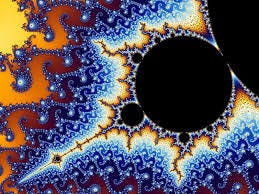
Fractals
Mathematicians had been describing these types of shapes since the late 1800s. But by giving them a name, Mandelbrot gave fractals value. He introduced a way to measure and analyze them. The name — from fractus, Latin for “broken” — helped recognize order in complexity.
Fractals’ hallmark trait is self-similarity. This means that no matter how much you zoom in or out, you find similar patterns.
Fractals describe patterns hidden all around us
There are so many fascinating things about fractals and to a certain extent fractal-like structures. They seem to offer a way out from reductionism, getting lost in the details, because of the way that they repeat at any scale, or in the case of fractal-like structures, at some scales.
It turns out that studying fractals has led to new forms of math and beyond, into unexpected areas of life.
In the last 50 years, fractals have led to new kinds of math. Now there’s fractal calculus and fractal algebra. But fractals are more than just a subfield of math. Their characteristic roughness helps scientists visualize chaos. They can model the evolution of changing systems. They help engineers find new designs for practical gizmos. They even inspire artists and musicians.
Modeling the evolution of changing systems sounds like emergence, doesn’t it?
Where Next?
I don’t know where this path will take me tomorrow.
Outside, a bird begins to sing, then falls silent.
The sky is gradually and slowly lightening while the clouds are still dark, lowering.
Wherever I end up, I am glad to be here with you.
Sometimes what emerges surprises us that's my writing all the time
This really resonates. I love the way you hold both the frustration and the curiosity of it, the sense that things are tangled and multiplying, and yet something is quietly gathering beneath it all.
The Hydra image is perfect. That feeling that you try to “solve” one thing and it opens into several others, not because you’re failing, but because everything is connected. The shift from seeing that as a problem to sensing emergence is really powerful.
I was especially drawn to the movement away from reductionism. That idea that we live so close to our own experience that we lose the wider pattern, and that practices like writing or reflection help us step back into something more whole, feels very true. It’s not about simplifying life, but about seeing it differently.
The fractal section fits beautifully with that. The idea of self similarity, patterns repeating at different scales, feels like such an apt way of describing inner work. It suggests that what feels chaotic might actually have a kind of structure, even if we can’t yet fully see it.
And the ending lands so gently. Not needing to know where it’s going, just noticing the light changing, the bird, the moment. That feels like the integration you’re pointing toward, not resolution, but presence within