26/40: Deeper
The 40 day journey continues and gets more challenging. Called away from frolicking in the shallows. Called to go deeper.

I started this 40 day journey in a spirit of adventure and play. It felt like it was going to be a lot of fun looking at all the ways I could let go of suffering. It was more like a game than a true exploration.
At least that is how it looks in retrospect. I believed myself to be taking it very seriously at the time. Probably I was, insofar as I could back then.
Back then. I mean, we’re talking about not quite a month ago. It isn’t unimaginably far away in the past, is it?
Emotional distance is fascinating that way. Chronological time is rather meaningless. Felt time supercedes all.
A couple of weeks ago I crossed a kind of personal Rubicon. I have since then been forced (forced? not really, perhaps invited is better) to look at aspects of myself that I struggle greatly with. It has been painful.
This is the path of going deeper.
It’s not really about transformation though everything feels different when I peel back the layers of self-protection that have kept things tidy, safe.
Encountering the Self in its way of being might feel like meeting a different me, because it has a feeling of Other in relation to the various hard-working parts that have done their utmost to bring me to this place.
I believe it is part of what fascinates me so about T.S. Eliot’s Little Gidding.
But I always go to the end. Look at where it begins:
Midwinter spring is its own season
Sempiternal though sodden towards sundown,
Suspended in time, between pole and tropic.
When the short day is brightest, with frost and fire,
The brief sun flames the ice, on pond and ditches,
In windless cold that is the heart's heat,
Reflecting in a watery mirror
A glare that is blindness in the early afternoon.
And glow more intense than blaze of branch, or brazier,
Stirs the dumb spirit: no wind, but pentecostal fire
In the dark time of the year.
The journey begins in the seemingly endless cold of ‘midwinter spring’, yet a cold bright in ice and a kind of fire. I know this cold. This is where I started.
You are not here to verify,
Instruct yourself, or inform curiosity
Or carry report. You are here to kneel
Where prayer has been valid. And prayer is more
Than an order of words, the conscious occupation
Of the praying mind, or the sound of the voice praying.
And what the dead had no speech for, when living,
They can tell you, being dead: the communication
Of the dead is tongued with fire beyond the language of the living.
In order to come to a level of true honesty with myself, I have to be willing to go deeper than mere verification of what I already know, to give myself nibbles of tasty information for the mind which loves candy, to indulge casual curiosity, even to give report, as one nurse does to another at the end of their shift and at the beginning of the next.
It requires kneeling, a level of humility that is difficult for one as proud and enamored of my own way and ideas as I, of finding the prayer that goes beyond words, liturgy, ideas that the living has about what life means, actually finding truth beyond the ordinary walks of life.
Once the dead has spoken, Eliot writes
There are three conditions which often look alike
Yet differ completely, flourish in the same hedgerow:
Attachment to self and to things and to persons, detachment
From self and from things and from persons; and, growing between them, indifference
Which resembles the others as death resembles life,
Being between two lives - unflowering, between
The live and the dead nettle. This is the use of memory:
For liberation - not less of love but expanding
Of love beyond desire, and so liberation
From the future as well as the past.
Attachment is necessary but a source of great suffering. Detachment is the mirror of it, a related suffering, while indifference is the death of love and life. The freedom comes not by loving less but loving more expansively, beyond desire which seeks to attach to both future and past.
Love.
Love is the unfamiliar Name
Behind the hands that wove
The intolerable shirt of flame
Which human power cannot remove.
We only live, only suspire
Consumed by either fire or fire.
It is only by fully confronting life, death, and the consuming fire that is love that any one can truly come to the end:
A condition of complete simplicity
(Costing not less than everything)
And all shall be well and
All manner of thing shall be well
When the tongues of flames are in-folded
Into the crowned knot of fire
And the fire and the rose are one.
Little Gidding (The Final Quartet), T.S. Eliot
There are no shortcuts to life, Reality As It Is, death, Love.
‘A condition of complete simplicity/ (Costing not less than everything)’
There is no easy slide into ‘all shall be well and/All manner of thing shall be well’.
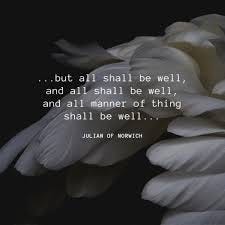
Julian of Norwich went through the most excruciated suffering and was very close to dying before she returned with that insight.
She was absolutely in a condition of complete simplicity and it cost her everything she had.
It’s far more than a slogan on a bag or an inscription on a bracelet, however beautiful.
Costing not less than everything
Wow
That shift you describe, from something that began in play into something much deeper and more costly, feels so real. It is often only in retrospect that we see we were standing at the edge of something far more profound than we understood at the time.
“Felt time supersedes all” especially landed. That sense that a few weeks can hold the weight of years when something inside begins to move.
I also felt the movement from understanding into something else entirely. Not knowing about, but kneeling before. That line, that it requires kneeling, feels so true. A kind of humility that is not comfortable, but necessary.
And I love the way you’ve woven in T.S. Eliot. Little Gidding feels like exactly the right companion for this kind of journey, that meeting of fire and stillness, of winter and something quietly burning underneath.
The distinction between attachment, detachment, and indifference also feels so important. Not loving less, but loving beyond the structures that try to contain it.
There is something in what you have written that recognises the cost without trying to soften it.
“A condition of complete simplicity (costing not less than everything)” feels less like an idea here, and more like something lived.