2/40: Transparency
Transparency is a quality of being whereby resistance to what is becomes diminished. This word came to me in meditation as the sounds of the early morning dark seeped me through.

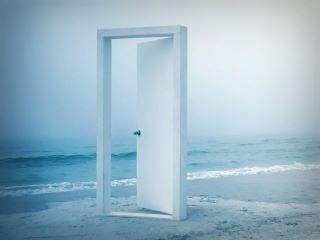
Do you know the feeling of being present to a moment, when discursive thought has sunk to a whisper that does not intrude, and everything simply is, in and through and around you?
It feels like transparency.
The first segments of this personal 40 day practice that has arisen for me of ‘letting go every encumbrance’ will centre letting go various kinds of suffering. Yesterday it was letting go of the suffering of control, to experience release and freedom.
Today the form of suffering that is being looked at with a view to letting it go is resistance.
Resistance Is Futile
It is likely you know of the concept of the Borg and their fiat to those they mean to conquer, “Resistance is futile.” It has become a meme or joke in popular Western culture, but actually points to a deeper and more significant emotional reality.
The depth psychologist Carl Jung posited long ago that what is resisted not only persists, but increases. This has become simplified through people like Eckhart Tolle to ‘what you resist persists’.
The flip side is presented in another bromide: ‘to get what you want, want what you get’. This PT article explains:
‘What links these two on-the-surface almost mystifying expressions is the underlying notion that it’s wise to accept what is, if only to put yourself in the best possible position to change it—or to achieve the freedom to move past it, and on to something else. And I should stress that I'm in no way intimating that you adopt a defeatist attitude in the face of what you deem inequitable or unjust, just that your resistance doesn't end up taking the form of resisting yourself.’
The Law of Attraction
The article goes on to talk about first to warn about the way the so-called universal Law of Attraction (LOA) can be overblown. In its encouragement to a passive approach as well as its emphasis on intention, it has become in too many a highway to spiritual bypassing, encouraging materialism, victim-blaming, and other dangerous forms of pseudo-spirituality.
So please do not take my bringing up the LOA in any way as an endorsement of it. For me it is too problematic.
I am more interested here in the principles that arguably inspired the LOA. For example, the Buddha taught thousands of years ago that the end of suffering comes through fully embracing it. A similar insight is found in Jesus’ words in John 12:25, ‘If you love your life, you will lose it. If you give it up in this world, you will be given eternal life’ (Contemporary English Version).
Both these teachings are related to the reality that much human suffering through resisting paradoxically leads clinging to things that trouble us and staying enmeshed in them rather than accepting them completely and thus gradually becoming free of them.
Part of the ‘energy’ the LOA speaks of is related to the phenomenon of attention. The frequency illusion or Baader-Meinhof phenomenon explains that just because one has recently learning something, it does not actually and suddenly start springing up everywhere. The PT article explains,
‘This cognitive bias leverages the brain’s penchant for pattern recognition: We direct selective attention to our novel discovery and scan the world for matches. We choose what to focus on and confirm more sightings of it—involving another cognitive bias, the confirmation bias, as well.’
So it will seem that what we attend to or focus on is ‘being attracted’. Focus on negative things, attract more negative, or focus on positive to attract more positive.
Letting the Walls Down
How many times have you heard in movies or read in books, or perhaps even said, “Let me in”? The traumas and wounds of early life often lead to people developing powerful fortresses around tender hearts. This becomes a barrier not only to romantic relationship but any connection with others.
The healing work of a good therapist, spiritual director, and/or trusted loved one or friend can help us, when the time is right, to gradually let the walls down and stop resisting others from entering into our inner world.
Those guards, protections, and boundaries have important purposes when it comes to sheltering vulnerable persons from abusive relationships and interactions. The issue comes when you trust someone and want to get closer, but the parts that served you so well in the past to keep abusers out now become problematic when the drawbridge cannot be let down, its mechanisms seized through years of holding and resisting.
Contemplation and Hope
Contemplative practice can allow humans to gradually soften our defenses and rigidity, our resistance to Reality As It Is, and to allow the beauty and wonder of what is around us to provide the strength and resilience as well as the hope needed to meet the very real, challenging aspects of daily life.
Attending to suffering, resisting, and closing off the heart and mind can make the world feel wholly dark and perilous.
Transparency of being allows the light to come in as well as the dark, the beauty as well as the ugliness, to grow into an openness to all of the complex aspects of living as humans in a world that can feel utterly filled with wonder while also having so much suffering all around us.
How can we go on without hope?
Liz Bucar in the Substack article from Religion, Reimagined, says
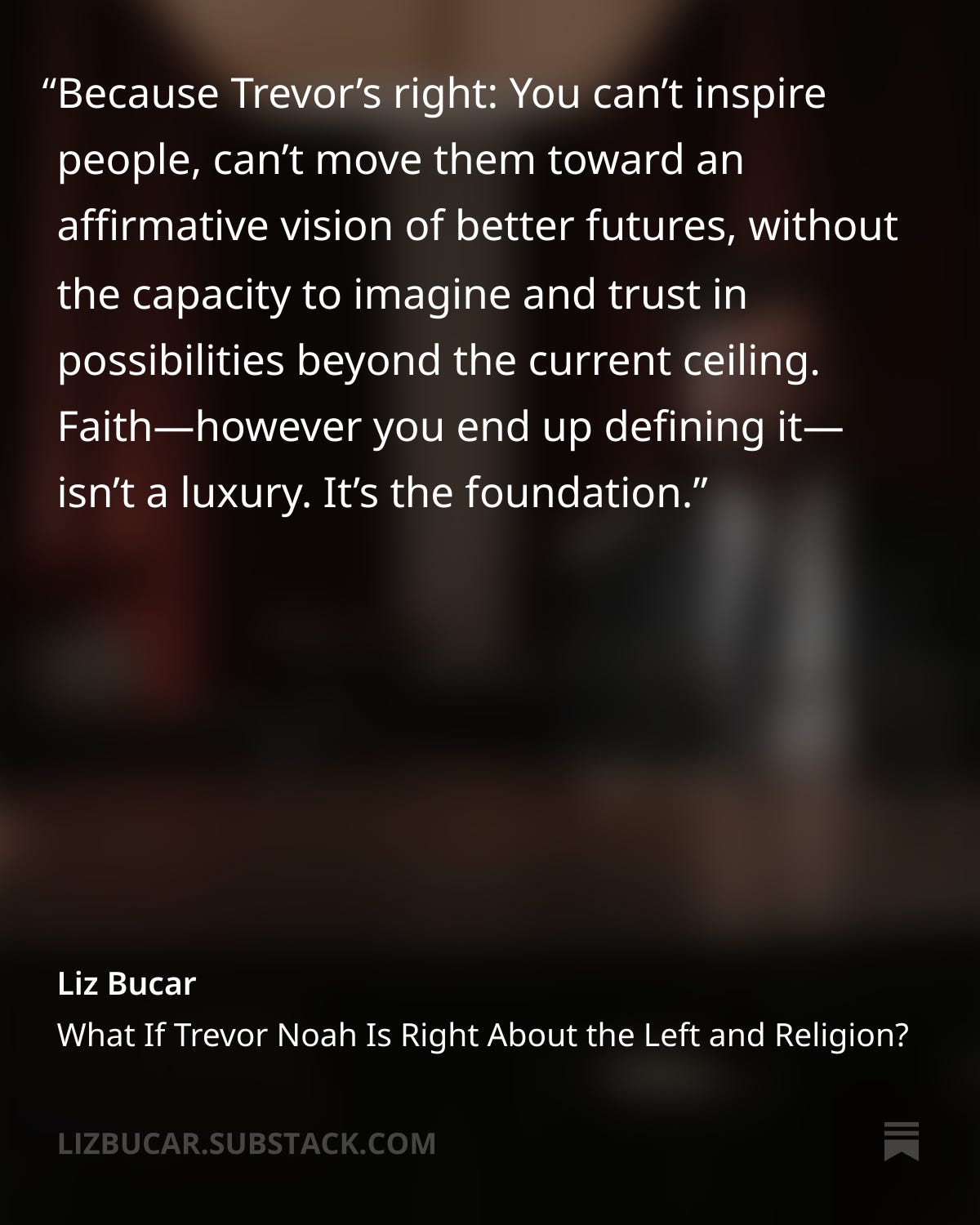
Source: What if Trevor Noah Is Right About the Left and Religion?
Liz points out, ‘It’s about deep cognitive and emotional capacities that religious traditions have spent literal centuries developing. And secular politics hasn’t figured out how to replicate them yet. Mamdani noticed that houses of worship still have trust while politics has lost it. Maybe that’s because religious communities have been practicing hope longer. They’ve developed what you might call technologies (okay, practices, frameworks, whatever) for sustaining vision through disappointment. For training people to believe in transformation they can’t see yet. For building the kind of trust that makes costly commitment possible.’
I have existed a long time in leftist circles, and many there are really struggling to find hope and a way forward. Contemplative practices, among other means, can help people loosen the mire of resistance and despair to move toward hope and life.
What is Resistance, In Your View?
What has your relationship to resistance been? How has it shaped your days? What are the ways you feel it has been helpful or hurtful?
On Ash Wednesday, I thought of Sting’s song “Fragile” - The ashes smudged on our heads remind us of how fragile we are. https://youtu.be/lB6a-iD6ZOY?si=6RYkpg51LF5j-oX-