22/40: Being Well
Wellness arguably has never been so heavily commodified. Curious about what it means to be and to stay well in 2026 as opposed to the suffering of illness

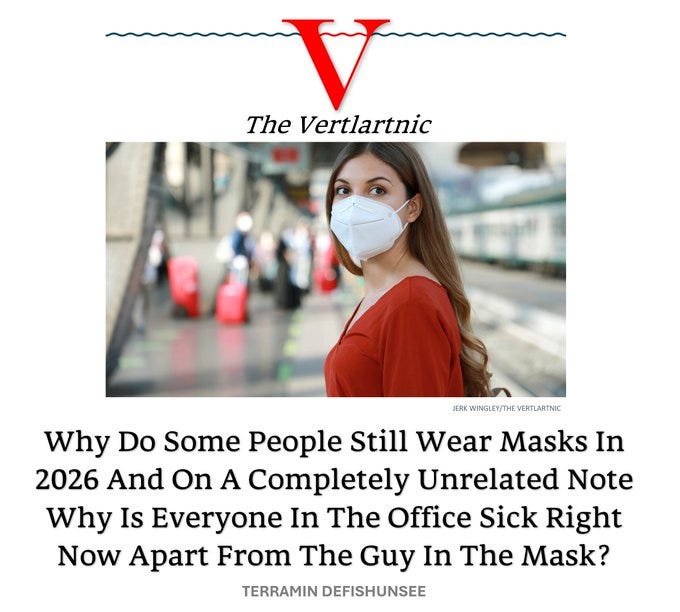
Vertlartnic Twitter status March 12 2026
We are well into the seventh year of the Covid pandemic, which began in China in November 2019 . Hundreds of millions of people have Long Covid. The risk others will get it rises significantly with each infection. A recent study indicates it is rare not to get Long Covid after 5 or more infections.
It is verifiable after multiple studies that Covid impacts every system in the body, and just about every aspect of the immune system, even for those without Long Covid. So it is not merely your imagination that more people are getting ill all the time. This report is about Americans but also true elsewhere: more are seriously ill and at a younger age.
Humans are illogical, full of contradictions. Then it is perhaps no surprise that people wearing masks today frequently face rage, abuse, and ridicule for their choice, though it is presumably common knowledge that many people have to wear them become of their compromised immune system or the vulnerability of someone they live with.
The harsh attitude to mask-wearing is particular true in places like Alberta where disinformation has been weaponised and politicised to a fine point.
Senator Paula Simons in her January article called Masking Fear writes:
Yes, I’m still wearing a mask. And yes, it takes some courage. Any time I post images of myself in a mask on my Facebook page, the insults and jeers come thick and fast, mocking me for wearing “a face diaper” or for being too stupid to know that COVID is “over.”
I’ve had strangers shout angry abuse at me as I walk through airports. But I think the most exasperating are the jokes and eyerolls from colleagues and family members, who seem to take my mask as a personal affront or insult. These friends and relations bug me—jokingly, but incessantly—to take it off, or tease me for what they perceive as my neurosis. I had one Senate colleague make fun of me for masking—only to tell me, in his next breath, that he was just getting over his fourth case of COVID.
Layered Wellness Strategy
We don’t see many people in public settings in masks anymore. Children at my learning centre sometimes ask me why I am wearing a mask when they see me in my N-95. I simply reply, “I wear a mask because I want to stay well.” I know it is unlikely they will understand what I am really saying, but they are usually too polite to ask follow up questions.
Any setting where there are a lot of children and young people naturally includes a lot of coughing, sniffling, and sneezing. I am grateful to parents who keep their children home when they are ill and to my staff who mask up and wash hands to avoid spreading germs but I know that small children in particular are just beginning to learn good hygiene practices.
Masking isn’t enough by itself. It is part of an overall layered strategy. I make sure I go every 6 months for Covid boosters. Sufficient good quality sleep, daily contemplation, and proper regular rest as needed are an essential part of staying well for me. And proper hydration, good food, vitamin and mineral daily supplements, and the other wellness practices I often mention here, are really important as well.
Air purifying is another fantastic way to reduce the viral load indoors and promote wellness. If only it were a priority in schools, hospitals, and large workplaces!
Why Do I Want to Stay Well?
I guess the question has to be asked, not because anyone actively wishes to be ill, but because there seems to be a greater general acceptance of illness as a necessary evil in the second quarter of the 21st century.
It feels that it’s ‘just the way it is’.
I am unwilling to become ill because
I already have a member of my family with Long Covid and do not wish to be the next one;
I do not wish to risk others close to me becoming ill because of me;
singing with my choir is one of my greatest joys. If I am ill, I cannot sing; and
because life is more enjoyable when I am well, so why be ill if I can prevent it?
The ‘Wellness’ Industry
New data on ‘wellness’ markets internationally tell us the following:
The five largest wellness markets are: the US ($2.1 trillion), China ($950 billion), Germany ($281 billion), Japan ($262 billion) and the UK ($261 billion). Together these five nations represent a whopping 58% of the total wellness economy.
Among the largest wellness markets, the standout five-year growth leaders are the UAE, Saudi Arabia, India, Mexico, Poland, the UK, the Netherlands, Canada, the US and Australia. For smaller markets, the growth stars include Croatia, Cuba, Romania, Costa Rica and Kazakhstan.
The new research is a story of global growth for wellness: Each of the top 25 largest markets have surpassed their pre-pandemic (2019) sizes, most by sizable margins, despite economic challenges for many of the nations. The growth shows that, as GWI partner economist Thierry Malleret put it, the wellness industry is not only resilient—it resists shocks—but is “anti-fragile”: it actually improves under stress and shocks.
I have added the bold face emphasis in the last sentence to make a point.
Of course going through a global pandemic, wars, worsening climate crisis, economic uncertainty, and other stressors would mean more profit for those who market ‘wellness’! How could it not?
The more fragile humans get and the more vulnerable we are to stress and illness, the more ‘anti-fragile’ wellness for profit gets. It feeds off of human illness and fear.
Is It Wrong to Profit in the Wellness Industry?
I do not think there is anything intrinsically wrong with making a living as a yoga instructor, a therapist, a spiritual director, a Tai Chi teacher, or any other of a vast array of professions whose work contributes significantly to billions of people becoming more well.
I am extremely grateful to my yoga instructor. She has been a huge support to me with her Yoga Nidra and gentle yoga classes, helping me to understand basic key things about myself like why once I started crying inconsolably when in child’s pose.
I have received more insight than I can easily explain in less than a year of working with my spiritual director. She’s amazing.
And I have learned so much that I really needed at those different times in my life when I was in therapy from every therapist I have had.
Spirituality and Complicity or Truth-telling
I am uneasy right now particularly with the complicity of so-called spiritual leaders with abuse. This has been an ongoing problem but a spotlight has been shone on it in the wake of the recent revelations about Deepak Chopra’s relationship with Epstein.
This Religion News article states
The apparent close bond between Epstein and Chopra has sent shockwaves through the spirituality and wellness industry. The friendship between the two seems to have begun in 2016, eight years after Epstein had pleaded guilty to soliciting sex from girls as young as 14. It continued after the 2018 Miami Herald report that Epstein had secured an extraordinary lenient plea deal — serving just 18 months for sex trafficking underage girls — for a crime that could have resulted in a life term in prison.
The good news is that some people in spirituality organisations are speaking up.
An early rebuke came from the Science and Nonduality Conference, a major site for contemporary spirituality. Acknowledging that they had platformed Chopra many times, they warned that when a “teacher becomes a brand” it is already a “red flag” and “often a sign that shadow is not far behind.” The group said the community should name the harmful dynamics that often operate in the spiritual arena — spiritual ego or the avoidance of psychological issues known as spiritual bypassing. SAND concluded that “spiritual discourse needs to belong into the realm of accountability, grief, and collective witnessing.”
I feel this is a healthy, laudable response and I hope to see more and more people work together for better accountability for those who have been abusive or colluding with abusers, and to provide space for those impacted by abuse to grieve and in time heal.
I understand why people who profit, in some cases to the tune of millions of dollars, from publishing, promoting, or otherwise working with abusive gurus would be reluctant to arrive at a place of giving up their profits and being honest about the harm that has been done.
But it is a level of hypocrisy that is hard to bear that people like this present as ‘spiritual’, promoting other ‘spiritual’ people, when so many have been harmed in ways that are sickening to witness because of these ‘gurus’.
Wellness is Not Fundamentally For Profit
I believe that a lot of people spend thousands of unnecessary dollars every year on books, seminars, pills, and other things heavily promoted by the ‘wellness’ industry.
I think that most of the wellness we need, physically, emotionally, psychologically, and spiritually can be found in ordinary good habits that we build daily in the company of trusted family and friends.
For those of us with the means and who find them helpful, it is wonderful to go on retreats, practise yoga at a studio, be in therapy, have a spiritual director, and so on. These can all be tremendous supports to becoming a more integrated person.
I personally reject a world where ‘wellness’ has become almost exclusively a commodity for the most privileged. People are constantly bombarded by excessive messaging from a plethora of sources that there is something wrong with us all.
We are told that we need these expensive scents, makeups, hair-dos, body sculpting, massages, etc to be fit to walk out the door in the morning without feeling ashamed.
We are told that we need this medication or that. (Note: not all medications are inherently bad. Some are necessary. But there is an entire pharmaceutical industry depending on people spending massive amounts of money on pills that demonstrably can make them worse, not better.)
We are told, in short, that it is through the spending of money that we become well.
If it were true, it would be terrible news for billions who cannot afford it.
The truth is that those wellness practices we do for the most part without a price tag (unfortunately proper food and vitamin/mineral supplementation has one) are the foundation of wellness.
We need to work together for a world where those who need healthcare can receive it. Where those who need therapy can get it regardless of their financial means, and aren’t forced to rely on ‘free’ AI which store all their conversations for unknown ends. Where all people can drink clean water and have adequate healthy food.
Wellness was never meant to be the exclusive property of a tiny minority.